

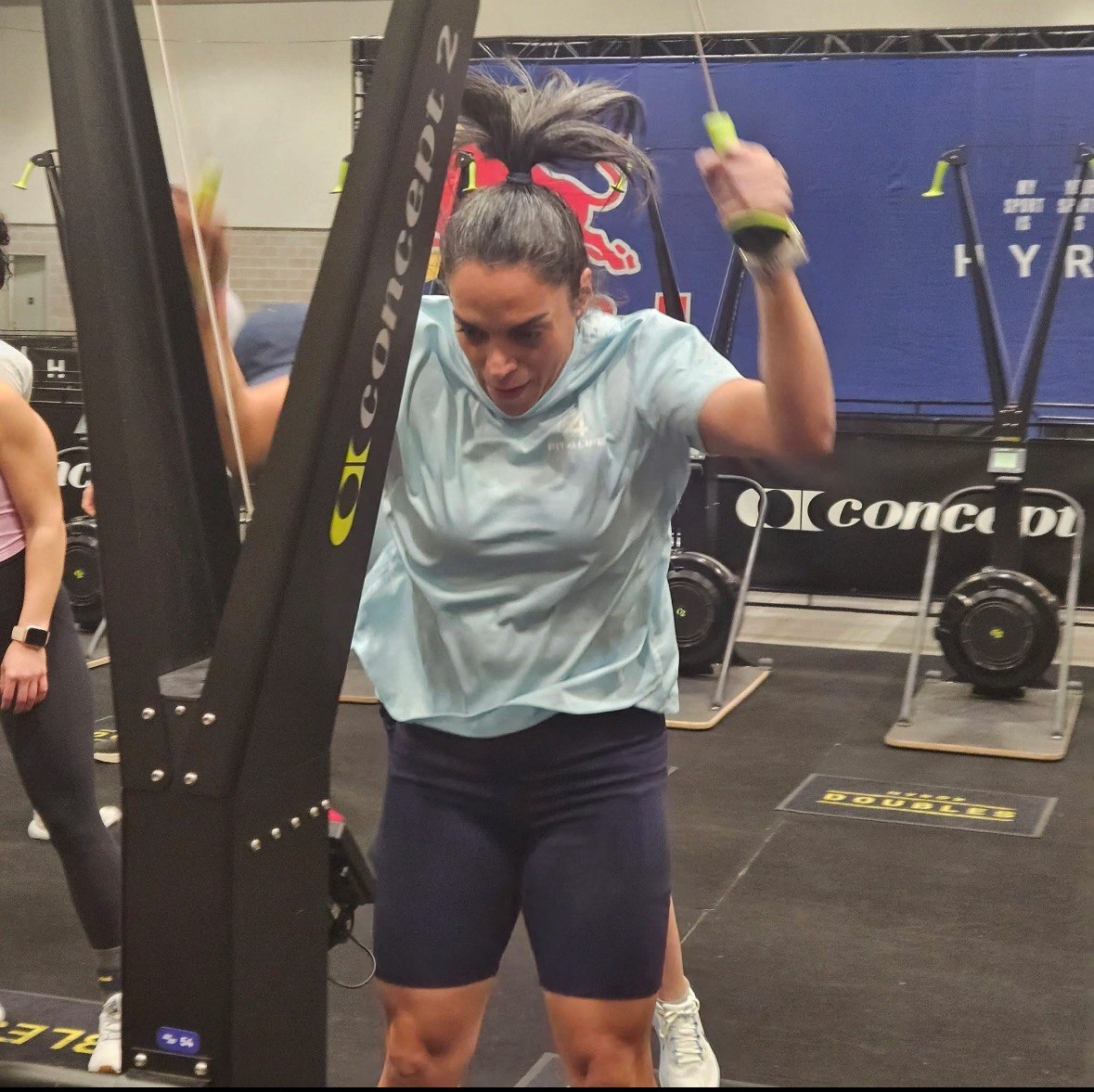
HYROX PFT & Full Race Simulation
Test yourself against the real thing. Fit 4 Life Club is the Official HYROX Training Club in Port Coquitlam, BC — we run coached HYROX Physical Fitness Test (PFT) assessments and full race simulations at official station weights, with timing, splits, and a coach debrief you can train from.
Where to do a HYROX PFT or race sim near Vancouver
Fit 4 Life Health and Fitness Club — 1515 Broadway St #503, Port Coquitlam, BC — runs coached HYROX PFT testing and full race simulations for athletes across the Tri-Cities and Greater Vancouver. Simulations are held as scheduled events in solo, doubles, and relay formats; PFT assessments run by appointment with a HYROX Level 2 Certified Performance Coach. No membership and no race ticket required. Call or text 778-284-7750 or email info@myfit4lifeclub.com.
What we test in a HYROX Physical Fitness Test
The PFT is a benchmark session, not a race. A coach scores you on the movement patterns that decide a HYROX result, then converts your numbers into target splits and a weekly plan. It takes about 60–75 minutes and is the fastest way to find out whether you are ready to sign up for a race.
SkiErg 500 m
Upper-body power and your opening pace ceiling.
Row 500 m
Anaerobic output and pull efficiency under fatigue.
Sled push & pull tolerance
The single biggest predictor of a blown-up race.
Wall ball max set
Leg endurance and breathing rhythm at station 8.
1 km run time trial
Baseline for your 8×1 km compromised-run pacing.
Burpee broad jump 40 m
Movement economy where most athletes lose minutes.
The race simulation, station by station
Eight 1 km runs alternating with the eight official stations at race weights, judged to race movement standards, with transitions timed like a roxzone. You get every split on paper afterwards.
- 1
1000 m SkiErg
Race-standard damper and pacing targets.
- 2
50 m Sled Push
Men 152 kg · Women 102 kg (sled included).
- 3
50 m Sled Pull
Men 103 kg · Women 78 kg (sled included).
- 4
80 m Burpee Broad Jumps
Chest-to-floor, two-foot take-off and landing.
- 5
1000 m Row
Split targets set from your PFT numbers.
- 6
200 m Farmers Carry
Men 2×24 kg · Women 2×16 kg.
- 7
200 m Sandbag Lunges
Men 30 kg · Women 20 kg, knee-to-floor standard.
- 8
100 / 75 Wall Balls
Men 6 kg to 3 m · Women 4 kg to 2.7 m.
Run 1 km between every station. Solo, doubles, and relay formats available. Members get a discounted rate through the Fit 4 Life Club app.
HYROX PFT vs. full race simulation: which should you book?
Both are coached, both are scored, and both happen at our Port Coquitlam club. The difference is what they are for — the PFT diagnoses, the simulation rehearses. Most athletes do a PFT first, train for 6–8 weeks, then run a full sim about a month out from race day.
| HYROX PFT | Full race simulation | |
|---|---|---|
| Purpose | Benchmark individual capacities and set targets | Rehearse the full race and validate pacing |
| Duration | 60–75 minutes including warm-up | 70–110 minutes of continuous racing |
| Format | Short scored tests, rest between efforts | 8 × 1 km runs alternating with 8 stations, no rest |
| Best timing | Start of a block, then every 6–8 weeks | 4–6 weeks out from your race |
| What you leave with | Scorecard, target splits, weekly plan | Full split sheet, roxzone times, coach debrief |
| Who it suits | First-timers and anyone unsure they're ready | Anyone with a race booked, solo, doubles, or relay |
Race simulation vs. an official HYROX race
A simulation is as close as you can get to race day without the entry fee and travel. Here is exactly where it matches an official HYROX event and where it differs.
| Fit 4 Life race simulation | Official HYROX race | |
|---|---|---|
| Station weights | Official HYROX weights | Official HYROX weights |
| Movement standards | Judged to race standards by a coach | Judged by official race judges |
| Runs | 8 × 1 km on our programmed course | 8 × 1 km on the event loop |
| Timing | Station-by-station splits, hand timed | Official chip timing and global ranking |
| Feedback | Immediate coach debrief and next training block | Results only |
Official standards, real coaching, no egos
Official HYROX Training Club
Race-format equipment and official weights on site in Port Coquitlam.
Level 2 certified coaches
Coaches who race themselves and judge to real movement standards.
Full split sheet
Station times, run splits, and transitions — plus a debrief and next block.
Open to everyone
First-timers, doubles teams, and podium chasers train side by side.
HYROX PFT & race simulation FAQ
What is a HYROX PFT?
A HYROX Physical Fitness Test (PFT) is a benchmark assessment that scores you across the same movement patterns used in a HYROX race — ski, row, sled, wall balls, burpee broad jumps, and running. At Fit 4 Life Club a coach runs you through each test, records every number, and turns the results into a training plan with target splits.
What is a HYROX race simulation?
A full simulation is the complete race format run under race conditions: 8 × 1 km runs alternating with the eight official stations at race weights, timed station by station with a roxzone-style transition. You finish with a full split sheet and a coach debrief so you know exactly where your time went.
Where can I do a HYROX PFT or full sim near Vancouver?
Fit 4 Life Club, 1515 Broadway St #503, Port Coquitlam, BC — about 35–45 minutes from downtown Vancouver and minutes from Coquitlam, Port Moody, Pitt Meadows, and Maple Ridge. We hold full race simulations as scheduled events and PFT assessments by appointment.
Do I need to be a member or have a race booked?
No. PFT assessments and race simulations are open to non-members, and you do not need a race ticket. Members get a discount through the Fit 4 Life Club app.
Can I do a simulation as a double or relay?
Yes. Our full sim events run solo, doubles, and relay teams, with the same station standards and timing for each format.
What is the difference between a HYROX PFT and a race simulation?
A PFT is a 60–75 minute benchmark of individual capacities — short erg tests, sled tolerance, a wall ball set, a 1 km time trial — scored station by station. A race simulation is the full 8 runs plus 8 stations run end to end, usually 60–110 minutes of continuous work. Use the PFT to find weaknesses and set training targets; use the simulation to rehearse pacing, transitions, fuelling, and race-day nerves.
How long does a full HYROX race simulation take?
Most first-timers finish a solo simulation in 90–110 minutes, experienced athletes in 70–85 minutes, and elite athletes under 65 minutes. Doubles and relay formats usually finish faster because the work is shared. Plan for about 2.5 hours at the club including warm-up, briefing, and debrief.
How often should I do a PFT or simulation?
A PFT every 6–8 weeks is enough to track progress across a training block. A full simulation is best 4–6 weeks out from your race — close enough to be specific, far enough to still fix what it exposes. Doing a second sim 10–14 days out at 80 percent effort is a good pacing rehearsal.
Is a race simulation the same as an official HYROX race?
The stations, weights, distances, and movement standards match the official race format, and we judge to those standards. What differs is the arena: no official timing chip, no official ranking, and 1 km runs are run on our programmed course rather than an event loop. Your simulation time is a strong predictor but is not an official HYROX result.
What is a good HYROX PFT score for a beginner?
As a rough guide for first-timers: SkiErg 500 m around 1:55–2:15 (men) or 2:15–2:35 (women), Row 500 m around 1:45–2:00 or 2:00–2:20, a 1 km run in 4:15–5:00 or 4:45–5:30, and completing the sled push and pull without stopping. Your coach compares your scores against target race times rather than a pass or fail.
Do I need my own equipment or race shoes?
No. All equipment is provided at official HYROX weights — SkiErg, rower, sleds, kettlebells, sandbags, and wall balls. Bring training shoes with a stable sole, water, and a towel. Race shoes are optional but useful if you want to rehearse race day exactly.
Can beginners do a HYROX simulation?
Yes, and it is one of the best ways to start. Coaches scale sled loads and wall ball targets when needed, keep you on a realistic pace, and stop the session becoming a blow-up. Plenty of athletes do their first simulation before ever registering for a race.
How should I prepare?
Treat it like race day: eat 2–3 hours before, arrive 20 minutes early to warm up with a coach, bring water, a towel, and your race shoes. Nothing else is required — we supply all equipment at official weights.